We’re excited to share a small but meaningful collection of restored black and white photographs from the Hydzik family. Thanks to a recent digital restoration session, these images, which document the lives of Polish immigrants in Perth, have been given new life.
While most of these photos show the family’s journey in Western Australia, we’re particularly interested in those from Sanok County, Poland. We believe some of these faces and stories are connected to that region, and we’d love to learn more.
Do you recognize anyone in these photos? Do you have any family history that connects to the Hydziks, either in Perth or back in Poland? Your knowledge could help us uncover the rich history behind these treasured images.
If you have any information at all, please get in touch. Every detail helps us bring these family memories to light.
“Outback Solitude” captures the stark beauty and isolation of the Australian outback in this evocative painting from the mid-1970s. The artist masterfully depicts a quintessential rural Australian scene: a solitary homestead with its characteristic water tank, set against a luminous sunset sky that transitions from deep amber to pale yellow.
The minimalist composition emphasizes the vast emptiness of the landscape, with the humble dwelling and its outbuilding appearing almost lost in the golden expanse. The artist’s subtle use of colour and horizontal brushstrokes creates a dreamy, atmospheric quality that speaks to both the harsh reality and romantic mythology of life in the Australian interior.
This work reflects the period’s growing appreciation for Australia’s unique landscape and cultural identity, rendered with both nostalgia and raw honesty. The warm palette and ethereal quality of light transform an ordinary outback scene into a meditation on solitude and human presence in the vast Australian wilderness.
Artist: John Hydzik (b. 1950)
Title: “Remnants of Yesterday” (1977)
Medium: Oil on board
Dimensions: 75 x 50 cm
“Remnants of Yesterday” showcases The artist’s masterful ability to capture the nostalgic essence of rural Australian life. This evocative piece depicts the juxtaposition of abandoned farm equipment against the enduring presence of a working windmill, creating a powerful narrative about the changing face of Australian agriculture.
The composition brilliantly frames weathered wagon wheels beneath the shelter of a grand eucalyptus tree, whose branches stretch protectively over these relics of pioneering days. In the distance, a solitary windmill stands sentinel against a soft, luminous sky, suggesting the continued presence of human enterprise in the landscape.
The artist’s technique demonstrates his characteristic attention to detail in the texture of rusted metal and weathered wood, while maintaining a dreamlike quality in the treatment of light and atmosphere. The artist’s use of a warm, golden palette punctuated by cool blues in the distant hills creates a sense of depth and temporal distance, inviting viewers to reflect on the passage of time in rural Australia.
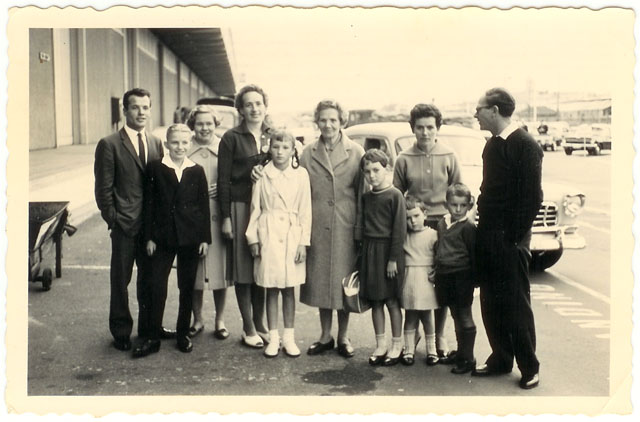
From left to right: Roman Hedzik, John Hydzik, Maria Hedzik, Veronica Hydzik, Danuta Hydzik, Maria Hedzik, Mary Matejcio, Teresa Matejcio (girl), Janina Matejcio, Peter Matejcio (boy) and Jozef Matejcio.
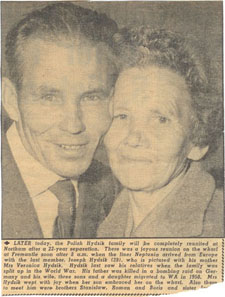
Later today, the Polish Hydzik family will be completely reunited at Northam after a 22-year separation. There was a joyous reunion on the wharf at Fremantle soon after 8 a.m. when the liner Neptunia arrived from Europe with the last member, Joseph Hydzik (39), who is pictured with his mother Mrs Maria Hydzik. Hydzik last saw his relatives when the family was split up in the World War. His father was killed in a bombing raid on Germany and his wife, three sons and a daughter migrated to WA in 1950. Mrs Hydzik wept with joy when her son embraced her on the wharf. Also there to meet him were brothers Stanislaw, Roman, and Boris and sister Janina.